A Digital Product Passport for every product, before ESPR deadlines
EU regulation requires a Digital Product Passport for every
product you sell. Root generates them at catalogue scale.
product you sell. Root generates them at catalogue scale.

ISO 14040, 14044
methodology
methodology

CSRD & VSME
aligned
aligned

Every source
traceable
traceable

Audit-ready
from day one
from day one
What gets in the way
Three reasons retailers
aren't ready for DPP
DPP needs data you've never had to structure
A Digital Product Passport (DPP) requires materials origin, production process, transport routes, recyclability, and repairability data. At product level. For every product. Most retailers have never had to structure or verify their data at this depth across a full catalogue.
It's an IT, data, and methodology project at once
Generating a passport for one product is doable. For thousands of products across multiple categories, it becomes three projects at once: IT, data, and methodology. No single team usually owns all three. The work stalls without a clear owner.
Estimates won't pass
an audit
an audit
DPP data has to be traceable and auditable. Generic industry averages won't pass regulator review. They won't pass your buyers either, because their compliance depends on the accuracy of your data.
How Root solves it
From scattered data to DPPs
at full catalogue scale
at full catalogue scale
Bring together the data you already have. Verify it against real sources.
Generate the evidence every DPP needs. Update the moment products change.
Generate the evidence every DPP needs. Update the moment products change.
01
Connect data
02
Verify inputs
03
Generate evidence
04
Stay updated
Step 1
Bring together the data you already have
Root works with the product data spread across your different systems and suppliers. Materials, origin, production, transport, recyclability, and repair data come together in one place. The same connection feeds your LCA, EPD, Scope 3, and ecodesign work.
Set up once, used for every report, footprint, or sustainability claim.
Set up once, used for every report, footprint, or sustainability claim.
Step 2
Verify every input against real sources
Every material, process, and transport step is matched to a verified emission factor or environmental impact figure from Ecoinvent or another verified database.
Generic unverified averages don't enter your DPP. Each data point shows where it came from. Each one stands up to a regulator's question.
Generic unverified averages don't enter your DPP. Each data point shows where it came from. Each one stands up to a regulator's question.
Step 3
Generate the evidence every DPP needs
The Ecodesign for Sustainable Products Regulation (ESPR) requires a structured environmental dataset behind every passport: lifecycle impact, material traceability, and full documentation.
Root produces it for every product in your catalogue at the same time.
Root produces it for every product in your catalogue at the same time.
Step 4
Keep every DPP up to date
New supplier? Changed material? New production process?
Root recalculates the affected products automatically.
The evidence behind every passport stays accurate without anyone touching a spreadsheet.
Root recalculates the affected products automatically.
The evidence behind every passport stays accurate without anyone touching a spreadsheet.
A DPP is a different regulatory record, but it draws on the same data
foundation. Root creates one for every product in your catalogue, from
the data you already have.
foundation. Root creates one for every product in your catalogue, from
the data you already have.


Want DPPs ready
before the deadline?
before the deadline?
What you get
You meet every
DPP deadline
without panic
DPP deadline
without panic
Every product in your catalogue has a DPP that meets the regulation. When a new sector falls under ESPR, you already have the data foundation in place. When a supplier sends new material data, your DPPs update. When a regulator or buyer scans the QR code, the record is live and accurate.
For the first time, compliance work doesn't grow with your product catalogue. The data is connected once. Every new product draws from the same foundation.
For the first time, compliance work doesn't grow with your product catalogue. The data is connected once. Every new product draws from the same foundation.
Benefits
Three ways DPP-ready data pays off
Win business that compliance alone can't
A DPP isn't just a regulatory record. It's a structured, verified record of every product you sell. Retailers who have one ready can answer buyer questions on the spot, in every B2B conversation where sustainability comes up. Retailers who don't lose ground.
Become the supplier buyers prefer
Major B2B buyers are already asking for DPP-ready data, before any deadline forces it. Their own Scope 3 reporting depends on yours. Retailers who can share a credible passport instantly become preferred suppliers. Competitors without one don't make the shortlist.
Move faster on every other report
The product-level data inside a DPP is the same data behind your LCA, EPD, Scope 3, and ecodesign work. Get it structured once, and every other report runs faster. Less data work. More time for actual impact reduction.
Why it matters
ESPR deadlines are set in EU law
The DPP rollout has a date for every sector. The countdown is already running.
Source:
European Commission, Ecodesign for
Sustainable Products Regulation (ESPR),
adopted May 2024; EU Battery Regulation
(2023/1542); Circular Economy Action Plan
implementation timeline.
Sustainable Products Regulation (ESPR),
adopted May 2024; EU Battery Regulation
(2023/1542); Circular Economy Action Plan
implementation timeline.
















Get started now
Get DPPs for every product
in your catalogue
In a guided demo, we show how Root turns your existing product
data into your first footprints.
data into your first footprints.
FAQs
Find quick answers to the most common questions about Root,
our methodology, data requirements, and timelines.
our methodology, data requirements, and timelines.
When does DPP apply to our products?
It depends on your sector. Batteries are first, from February 2027. Textiles and apparel follow from summer 2027, then furniture and electronics from 2028. The EU is rolling out DPP requirements category by category through 2030.
What data goes into a DPP?
A DPP carries material composition, origin, supplier information, environmental impact, repairability, recyclability, and end-of-life data. The exact fields depend on the product category. Root maps the requirements to your existing data and flags what's missing.
How does the QR code work?
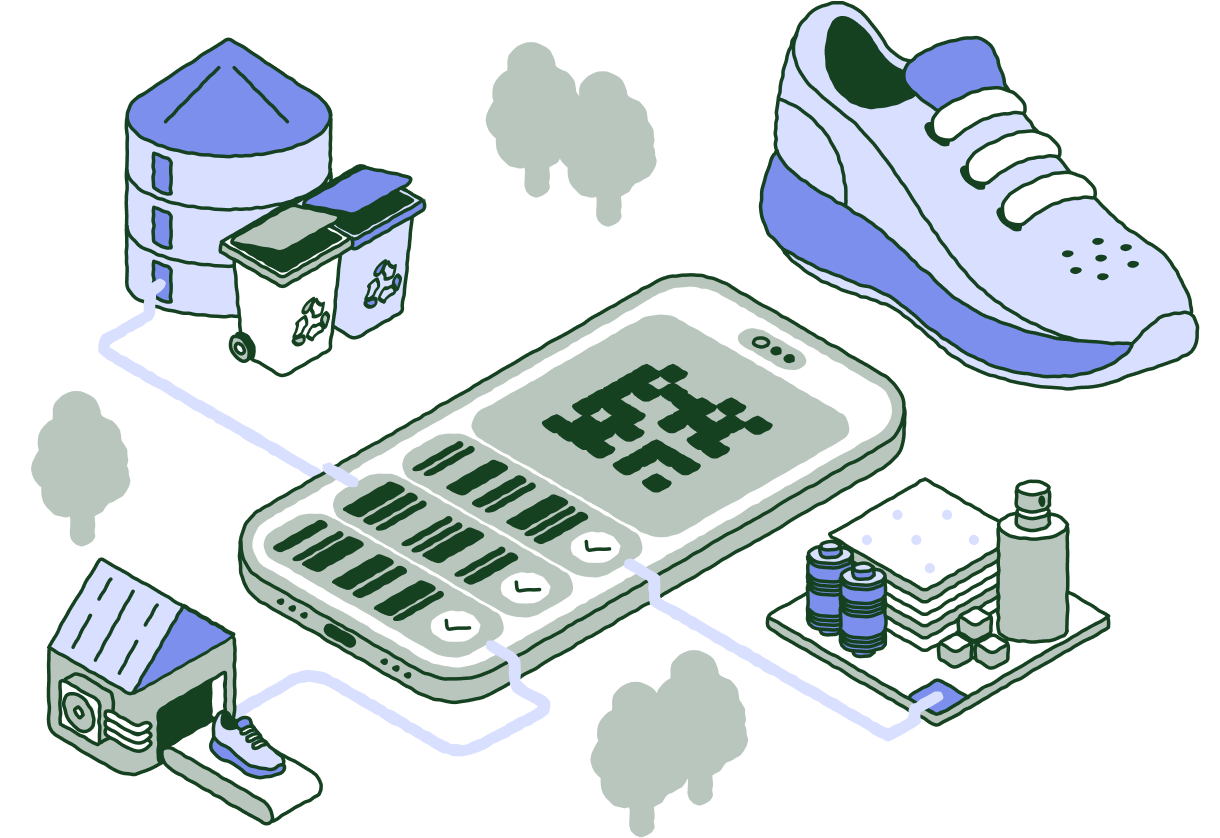
Each product carries a QR code or similar data carrier such as an NFC tag or digital watermark. When scanned, it shows the live DPP. Root provides the structured data that sits behind the carrier, ready to be displayed when scanned.
What if our suppliers can't give us the data?
Root has a built-in supplier portal. You send data requests directly to your suppliers from inside the platform. They fill in what's needed without accessing your full dataset. The data appears in Root automatically when they respond.
We use other tools for product data. Can Root work with them?
Yes. Root works with the data from your existing systems. We structure that data inside Root's framework and flag what's missing.